


Words with Foxy
4.4160.00 Reviews
App Specs
- Version
- 2.2.82
- Updated On
- License
- Free
- Downloads
- 50,000+
- Developer
- DonkeySoft Inc.
- Categories
- Word
- Platform
- Android
Screenshots
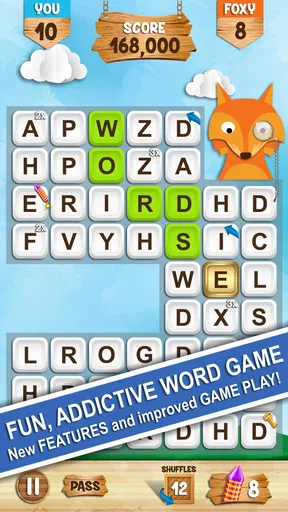
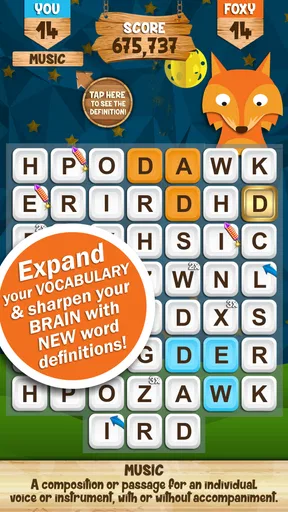
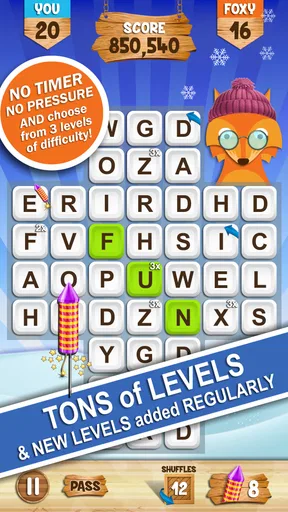
 Analysis by AppCompare
I went into Words with Foxy expecting a familiar word-game routine, but its most useful idea is more focused than that: it gives me a direct opponent in Foxy, so each round feels like a small test of my current word-game ability rather than an endless exercise with no clear comparison. That simple setup changes how I play. I am not only searching for words; I am deciding whether my choices are strong enough to keep pace.
This is a free word game from DonkeySoft Inc., aimed at Everyone and available for Android devices running at least Android 7.0. It has reached over 50 thousand installs and holds a 4.4 average from more than 500 ratings, which suggests that its straightforward format has found a willing audience. The game was released in June 2017, and its current version is 2.2.82.
Playing against Foxy gives the game its purpose
The central capability is the opponent. Many word games let me build words, solve clues, or complete a board, but they do not always tell me how well I performed beyond a score or a finished puzzle. Here, Foxy acts as a practical reference point. I can judge my choices by asking a more immediate question: am I playing well enough to challenge this opponent?
That makes the experience feel closer to a compact skill check than a conventional vocabulary lesson. I do not need to set up a match with another person, wait for someone to respond, or compare results with a leaderboard before I understand whether a round went well. Foxy is ready whenever I am, making the game suitable for short sessions when I want a quick mental challenge.
The opponent is more important than the word-game label. Without that comparison, the game could easily blend into the large group of casual word titles. With it, every decision has a little more weight. A safe word may keep me moving, but a better word can be the difference between feeling in control and falling behind.
I also like that this design gives the game a clear learning loop. I play a round, notice where my choices were weak, and try to make sharper decisions next time. It is not the same as studying a dictionary, and I would not use it as a replacement for a structured language course. Its value is in repeated practice under light pressure.
How the challenge feels during an ordinary session
In practice, I approach each turn with two competing instincts. The first is to choose a word quickly so I do not waste an opportunity. The second is to pause and look for a more valuable or strategically useful option. That tension is what makes the opponent meaningful. If I play too cautiously, I may miss stronger possibilities; if I overthink every move, the session loses its relaxed rhythm.
Worth Reading Before You Choose

EA SPORTS FC Mobile 26 Is a Bigger Football Game, but It Takes Time

Flipboard Shows What News Apps Must Do Beyond the Feed

Switching to Android Auto Means Rethinking Your Driving Routine

Google Calendar Makes a Crowded Week Easier to Manage

Ludo King Makes the Most of the Minutes Between Plans

Baby Panda World Brings Quick Play to Modern Phones, but Its Game Library Feels Busy
For a beginner, the game can work as a gentle introduction to competitive word play because the goal is easy to understand. I do not have to learn a complicated story or manage a large collection of systems before getting started. I can concentrate on recognizing words and making better choices. For a more experienced player, the appeal comes from refining instinct: spotting useful combinations sooner and avoiding mediocre moves made only because they are convenient.
One practical tip is to treat the first few rounds as observation rather than proof of ability. I found it more useful to notice the kinds of decisions that make me lose momentum than to focus only on the final result. If I repeatedly choose the first acceptable word I see, the game exposes that habit. If I spend too long searching for an ideal move, it exposes that too. Foxy turns those tendencies into something I can see during play.
Another useful approach is to play when I have enough attention to compare alternatives. This is not the best game for half-reading a message while playing, because the main benefit comes from the small decisions between an obvious word and a better one. A short, focused session can be more satisfying than a longer distracted one.
A realistic everyday use case
The best scenario for me is a spare ten-minute window: waiting for an appointment, taking a break between tasks, or sitting with a coffee before starting the day. I can open the game, play against Foxy, and leave with a clear sense that I exercised my vocabulary and decision-making without committing to a long campaign.
It also works well as a personal warm-up. Before tackling a crossword, a word puzzle, or another language-heavy activity, I can use a round to get my mind searching for possibilities. The game does not need to replace those alternatives. Instead, it provides a more immediate opponent-based challenge, while a crossword may offer richer clues and a traditional word puzzle may reward deduction in a different way.
For families, the Everyone rating makes the game approachable across age groups, although the experience is still most useful when players are comfortable reading and forming words. I can imagine passing a device around and comparing how different players react to the same kind of challenge. It is less about a shared multiplayer event and more about seeing who can make the strongest individual showing against Foxy.
There is also a good use case for players who dislike social competition. Some people want pressure without the awkwardness of playing against strangers or coordinating with friends. This setup offers that middle ground. I get an opponent-like experience while keeping the session private and self-contained.
Where it differs from familiar word-game alternatives
Compared with a crossword, Words with Foxy is less about following a chain of clues toward one intended answer. A crossword rewards patience, general knowledge, and the satisfaction of unlocking a grid. This game is more immediate: I am making choices in response to an opponent, so the feeling is closer to a contest than a solitary puzzle.
Compared with a word-building game that focuses mainly on a board or a personal score, the Foxy element gives me a stronger reason to care about efficiency. A high score can be satisfying, but a visible rival creates a more understandable target. I can tell whether I am merely participating or actually performing well.
On the other hand, players who want a rich narrative, a large progression system, or a deep multiplayer community may find this format too narrow. Its strength is concentration. It does not need a large number of distractions to make a round worthwhile, but that also means it may not hold the attention of someone looking for a broad, content-heavy game.
I would also choose a traditional spelling or vocabulary app over this one if my primary goal were systematic instruction. The game can encourage word awareness, but it is still entertainment first. It helps me practice decisions in a playful setting rather than presenting lessons in a carefully ordered curriculum.
The tradeoff between simplicity and depth
The clean focus is both the game’s biggest strength and its main limitation. I appreciate being able to start quickly and understand the basic purpose without a long explanation. At the same time, players who need constant novelty may eventually want more variety than a single opponent-centered concept provides.
That does not make the game shallow by default. Repeated play can reveal different weaknesses in my approach, especially if I stop treating each round as a race and start examining why I made particular choices. Still, the depth comes largely from my own willingness to improve. Someone looking for frequent new mechanics may not get the same value.
The free price makes trying it uncomplicated, but in-app purchases range from $1.49 to $11.99 per item. I would recommend starting with the free experience and deciding whether the core challenge fits my habits before spending anything. The purchase range is worth keeping in mind for anyone who prefers games with no optional spending at all.
The age rating of Everyone is another positive for accessibility, but it should not be confused with universal appeal. A young player may enjoy the competitive idea, while a dedicated adult word-game fan may want more complex boards, tougher opponents, or more detailed progress tracking. The rating tells me who can access the game; it does not guarantee that every age group will find the same level of challenge.
Device compatibility is also reasonably broad for Android users because the game supports Android 7.0 and later. That makes it a practical option for people who are not using a recent phone. I would still judge it by how smoothly it fits my particular device and routine, but the minimum operating-system requirement does not force me toward the newest hardware.
Small habits that make the opponent more useful
I get more from the game when I avoid chasing speed for its own sake. My first instinct in a timed-feeling word challenge is often to select whatever appears immediately. Instead, I try a quick scan: can I see a stronger word, a more efficient arrangement, or an option that keeps my next decision open? That extra moment is where the opponent changes the experience from casual tapping into deliberate practice.
I also recommend keeping a mental note of recurring mistakes rather than trying to remember every word. If I notice that I overlook short, flexible options or waste time searching for rare vocabulary, I can adjust in the next round. This makes the game useful even when I do not win. The result becomes feedback about my playing style, not just a judgment.
A third tip is to separate vocabulary weakness from decision weakness. Sometimes I may know plenty of words but choose badly under pressure. At other times, I may make sensible choices but lack the vocabulary to find a stronger move. Playing several short sessions with that distinction in mind helps me understand what I am actually trying to improve.
That is a more valuable use of the game than simply opening it whenever I am bored. The opponent gives me a framework for self-review, but I have to supply the attention. If I do, even a compact round can tell me something about how I search, prioritize, and react.
Who will get the most from it
I would recommend this game to someone who enjoys word challenges but wants a clear rival instead of an isolated puzzle. It is especially suitable for casual players who want short sessions, readers looking for a light vocabulary workout, and people who prefer solo competition over online matchmaking. The straightforward concept also makes it easy to share with a family member who already likes word games.
It is less suitable for players who need a story, extensive customization, or a constantly changing set of mechanics. I would also point a serious language learner toward a dedicated educational tool if they want definitions, graded exercises, pronunciation practice, or a planned study path. Those needs are different from what this game is designed to provide.
For me, the deciding question is whether playing against Foxy sounds more motivating than solving words alone. If the answer is yes, the game has a clear reason to stay installed. If I only want relaxed puzzles with no competitive pressure, a crossword or another solo format may be a better match.
Its established presence is reflected in the 4.4 average and more than 500 ratings, while the 50-thousand-plus install count shows that it is not an obscure experiment. Those figures do not replace personal taste, but they support my impression that the compact opponent-based format works for a meaningful group of players.
My recommendation after playing
Words with Foxy succeeds because it gives a familiar word-game activity a clear point of comparison. Foxy is not just decoration; the opponent turns each choice into a small performance test and gives repeat sessions a practical purpose. I found that more engaging than simply collecting points without knowing what they meant.
The game is free to try, rated Everyone, and maintained in version 2.2.82, with optional in-app purchases between $1.49 and $11.99 per item. I would begin without spending money, play enough rounds to see whether the opponent motivates me, and then decide whether the extra purchases fit my expectations.
My final view is positive but specific: this is a good pick for focused, solo word competition in short bursts. It is not the right choice for structured language study or a large, constantly evolving game world. If you want a simple way to test your word-game instincts against Foxy and improve through repeated decisions, I think it is worth installing.
Pros
- Simple word puzzles are easy to learn and suitable for quick sessions.
- The fox theme gives the game a friendly
- distinctive personality.
- Helpful hints can make difficult levels feel less frustrating.
- Progressive challenges keep the gameplay engaging over time.
- Works well for players who enjoy casual vocabulary practice.
Cons
- Some puzzles may feel repetitive after extended play sessions.
- Advanced levels can be difficult without using hints.
- The game may appeal less to players seeking competitive features.
- Limited gameplay variety could reduce long-term replay value.
- Ads or in-app purchases may interrupt the otherwise relaxed experience.
FAQs for Words with Foxy
What is Words with Foxy?
Words with Foxy is a casual word puzzle game centered on forming words from available letters. It is designed for short, relaxing sessions while still offering enough challenge to keep regular players interested. The fox-themed presentation gives the game a friendly personality, and the straightforward controls make it accessible even if you do not usually play word games.
How do you play Words with Foxy?
Gameplay generally involves examining the letters shown on the screen and combining them to create valid words. Depending on the level or mode, you may need to discover a specific number of words, complete a target, or solve a themed puzzle. Progress becomes more demanding over time, so looking for shorter words, rearranging letters, and using hints strategically can be helpful.
Is Words with Foxy free to download and play?
Words with Foxy can typically be downloaded without an upfront purchase, allowing you to try the core word puzzles before spending money. However, free versions of mobile games may include advertising, optional purchases, or limits on certain resources such as hints. Check the store listing on your Android or iOS device for the current pricing, ads, and in-app purchase details.
Does Words with Foxy require an internet connection?
The basic puzzle experience may be available without a continuous internet connection, which makes Words with Foxy suitable for playing during travel or when mobile data is unavailable. Nevertheless, an internet connection may be needed for downloading updates, displaying advertisements, synchronizing progress, accessing online features, or completing purchases. Availability of offline functions can vary between versions and devices.
Is Words with Foxy suitable for children and families?
Words with Foxy is generally appropriate for players who enjoy vocabulary and word-building challenges, including families looking for a simple game to play together. Parents should still review the current age rating, advertising settings, and in-app purchase options before allowing younger children to play. Difficulty, vocabulary requirements, and any online features may also affect whether it suits a particular child.


